

How to Audit Your Website for AI Search Readiness
A step-by-step GEO audit framework covering the three pillars of AI citation readiness: Structural Richness, Chunkability, and Factual Density. RankAsAnswer automates the entire process in under 60 seconds, but this guide teaches the manual approach so you understand what you are measuring.
What a GEO audit measures
A GEO audit measures how well a page is prepared to be retrieved by vector databases and cited by LLMs. Unlike an SEO audit — which measures crawlability, keyword optimization, and link profile — a GEO audit measures the structural, semantic, and informational properties that determine whether content survives AI parsing, gets embedded with high retrieval quality, and earns citations in generated responses.
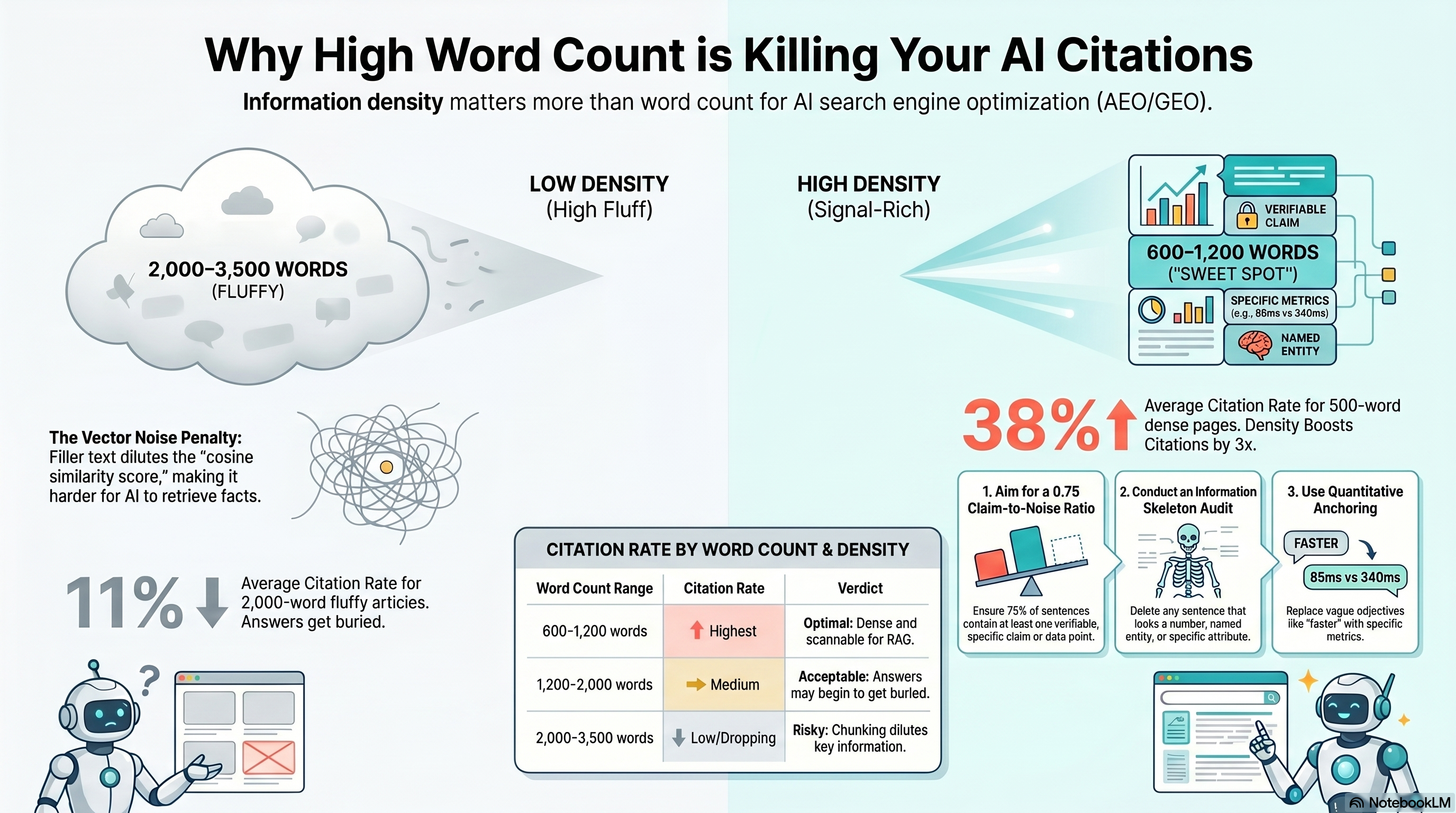
The three pillars of a GEO audit are: Structural Richness (does the content survive DOM parsing and carry semantic HTML signals?), Chunkability (is the content organized into independent, self-contained units that perform well as isolated chunks?), and Factual Density (does each chunk contain enough specific facts to embed with high semantic precision?).
Audit scope recommendation
Start with your 10 most important pages — the pages you most want AI to cite. These are typically your homepage, product pages, feature comparison pages, and your top 5 blog posts by intended search intent. A GEO audit of 10 pages takes 2–3 hours manually or under 10 minutes with RankAsAnswer.
Pillar 1: Structural Richness
Structural Richness measures whether the page's HTML architecture communicates content meaning to parsers. Check each of the following:
Quick test: run the page through Firefox Reader View. If the output is clean, well-structured text with headings and lists intact, you pass Structural Richness. If the output is garbled, missing sections, or displays navigation instead of content, you have a structural failure.
Pillar 2: Chunkability
Chunkability measures whether the content is organized into independent, self-contained units that will perform well when retrieved as isolated chunks. Check each of the following:
Quick test: extract one paragraph at random from the middle of your page. Read it without any surrounding context. Does it make complete sense? Does it convey a specific, verifiable claim? If not, it has a chunkability failure.
Pillar 3: Factual Density
Factual Density measures the ratio of information-bearing tokens to total tokens in each chunk. Check each of the following:
GEO audit scoring guide
Score range Rating Typical action
- →17–18 checks pass
- →Excellent
- →Minor Schema additions only
- →13–16 checks pass
- →Good
- →Target 2–3 specific pillar gaps
- →9–12 checks pass
- →Fair
- →Content rewrite + Schema implementation
- →5–8 checks pass
- →Poor
- →Structural overhaul + content rewrite
- →0–4 checks pass
- →Critical
- →Full GEO rebuild required
Schema audit
Check Schema implementation with the following: Does the page have at least one Schema type relevant to its content (Article, FAQPage, Product, HowTo, Organization)? Is the Schema valid (no errors in Google's Rich Results Test)? Does FAQPage Schema exist on pages with Q&A structure? Does the Organization Schema on the homepage include sameAs links? Does Article Schema include dateModified from the current year?
Schema is the highest-ROI GEO fix category. A page with zero Schema that adds FAQPage and Article Schema typically sees 2–3x citation rate improvement within 2–4 weeks of re-indexing.
Trust signals audit
Check trust signals: Does the page cite at least one external authoritative source (.gov, .edu, or primary research)? Is there an author byline with Person Schema and verifiable credentials? Does the Organization Schema on the domain include founding date and sameAs links? Is there a Wikidata entry for the organization or key entities?
Automating with RankAsAnswer
RankAsAnswer automates all 18 GEO audit checks across all three pillars plus Schema and trust signals, producing a single 0–100 GEO score with a prioritized fix list. The audit runs in under 60 seconds per URL. For large sites, the batch audit processes multiple URLs in parallel, producing a site-wide GEO score distribution in under 10 minutes.
The one-click fix feature generates exact Schema blocks, semantic HTML wrappers, and Answer-First sentence rewrites for every identified gap. The fixes are copy-paste ready for deployment directly to your CMS.
Prioritizing fixes from audit results
Apply fixes in this order of impact per unit effort: FAQPage Schema (highest ROI, lowest effort), semantic HTML container fixes (<main>, <article>), ISO 8601 timestamp implementation, direct answer sentence rewrites for H2 openers, conversion of comparison paragraphs to HTML tables, Article Schema with dateModified, Person Schema for authors, and Organization Schema with sameAs links.
Run your GEO audit now All 18 checks automated in 60 seconds. Score + prioritized fixes. The Answer-First framework The five-part GEO-optimized content template for implementing audit fixes.
Continue reading
All articlesHow Generative Engine Optimization Works: The Technical Architecture Behind AI Citations
Understand the mechanics of how AI answer engines select, extract, and cite sources. Learn how GEO aligns your content with the retrieval-augmented generation pipeline that powers ChatGPT, Perplexity, and Gemini.
What Is Generative Engine Optimization? The GEO Manifesto for 2026
Generative Engine Optimization (GEO) is the practice of making your content citable by AI answer engines like ChatGPT, Perplexity, and Gemini. Learn why GEO is the next frontier beyond traditional SEO.
How to Do Generative Engine Optimization: The Complete Implementation Guide
A step-by-step guide to implementing Generative Engine Optimization on your website. Learn exactly how to do GEO from initial audit through Schema deployment and ongoing maintenance.
How to Learn Generative Engine Optimization: A Practitioner's Roadmap
A structured learning path for mastering Generative Engine Optimization. From foundational concepts through hands-on practice to advanced specialization — everything you need to build real GEO skills.
The $0 AI Visibility Audit: Check What Every Major LLM Is Saying About Your Brand Right Now
A structured 20-prompt audit across ChatGPT, Gemini, Perplexity, and Claude that any marketer can run today. Includes scoring rubric, pattern analysis, and what to do with the results.
Narrative Drift: How AI Models Are Quietly Changing What They Say About Your Brand
The story an LLM tells about your brand today may be completely different from what it told 3 months ago. Narrative Drift is measurable, consequential, and fixable — here's how.