

The Answer-First Framework: Restructuring Blogs for AI Overviews
The GEO-optimized blog post follows a five-part structure: direct answer sentence, brief explanation, bullet-point facts, Markdown comparison table, and FAQ Schema. This template applies the primacy/recency rule, information density principles, and Schema injection in a single, implementable content format.
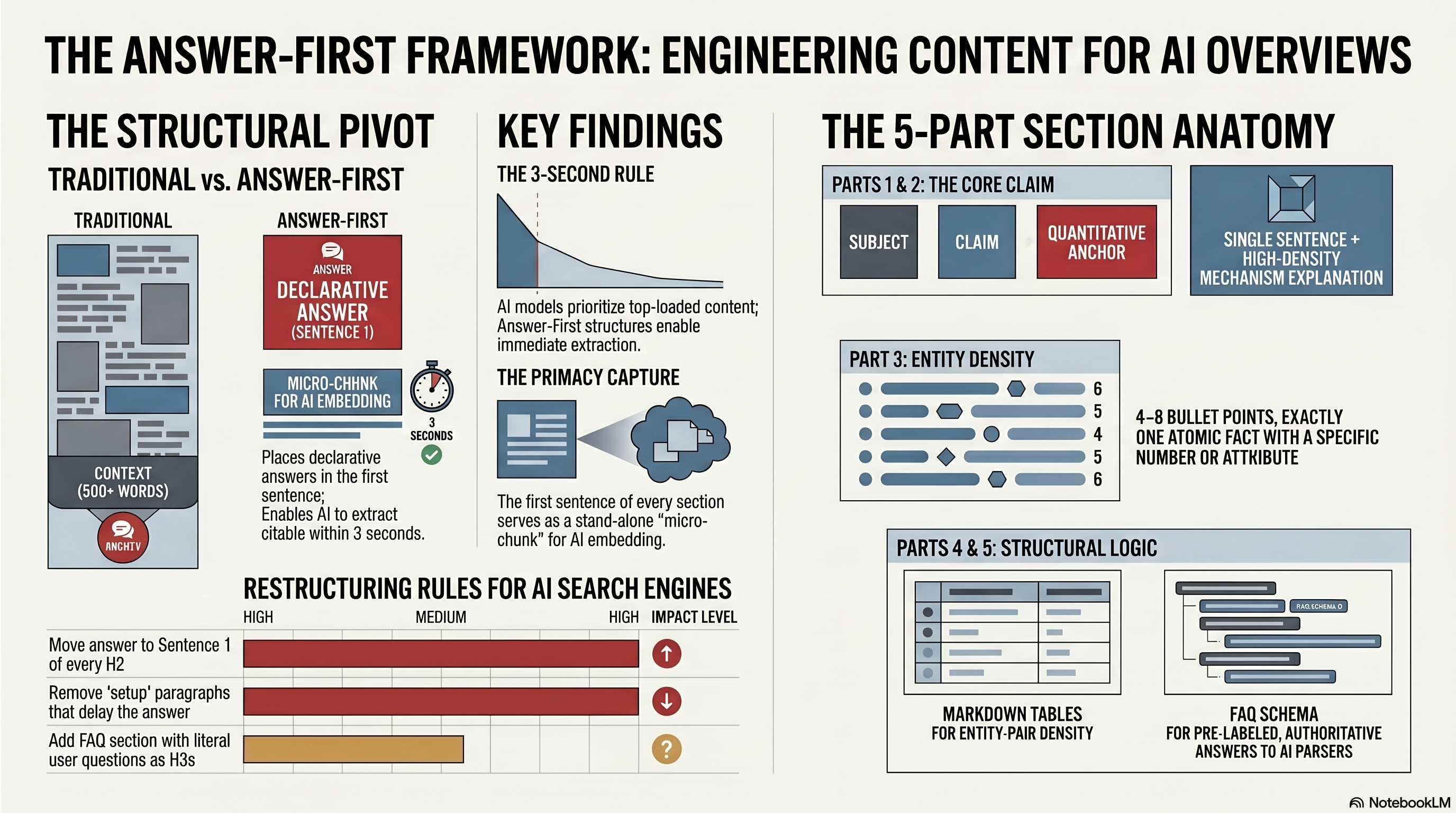
The five-part framework
The Answer-First framework restructures each H2 section of a blog post into five sequential components that apply all major GEO optimization principles simultaneously. Each component serves a specific retrieval or citation function. Together, they create a section that is optimized for the primacy position, information density, structural parsing, and Schema-injected context.
The five-part Answer-First section structure
- →1
- →Direct answer sentence
- →1 sentence
- →Primacy capture, span alignment
- →2
- →Short explanation
- →2–3 sentences
- →Context + supporting facts
- →3
- →Bullet-point facts
- →4–8 bullets
- →Entity density + scannability
- →4
- →Comparison table
- →Optional, where applicable
- →Structural parsing + entity pairs
- →5
- →FAQ Schema
- →2–3 Q&As per section
- →Schema injection + direct context window
Part 1: The direct answer sentence
The first sentence of every H2 section must directly and completely answer the question implied by the heading. No setup, no context, no qualification. One declarative sentence, Answer-First structure: Subject → Claim → Quantitative anchor.
This sentence serves as the primacy-position capture: if only one sentence from your chunk gets into the context window synthesis, this is the one. It must be complete enough to stand alone as a citable fact.
Example heading: "How long does AEO optimization take to show results?" Direct answer sentence: "AEO optimization produces measurable citation rate improvements in 2–4 weeks for structural changes (Schema, semantic HTML) and 2–4 months for content density improvements, based on data from 200+ sites tracked through RankAsAnswer."
Why one sentence?
The direct answer sentence corresponds to a single token chunk boundary — approximately 30–50 tokens. At this length, it functions as a complete micro-chunk that embeds with maximum semantic specificity. Two-sentence openings dilute this effect by merging two semantic units into one embedding.
Part 2: The short explanation
The explanation block is 2–3 sentences that provide the mechanism, context, or qualification for the direct answer. This is where you explain the "why" behind the claim, provide the conditions under which the claim holds, and name the key entities involved.
Each sentence in the explanation should contain at least one specific, named entity or quantitative claim. Avoid pure transitional sentences that contain no facts. The explanation block should maintain a claim-to-noise ratio above 0.75.
Part 3: Bullet-point facts
The bullet-point block serves two functions: entity density maximization and scannability for humans. Each bullet point should contain exactly one atomic fact — a single verifiable claim with a quantitative anchor.
Bullet point format requirements: start with the entity name or key concept, include a specific number or attribute, end at the fact (no elaboration). "FAQPage Schema: 3.1x citation rate increase over pages without Schema (RankAsAnswer data, n=1,200 pages)" is a complete bullet. "FAQPage Schema is very helpful for citations" is not.
Target 4–8 bullets per section. Fewer than 4 misses the entity density benefit. More than 10 introduces diminishing returns and risks Repetition Entropy if the bullet format becomes monotonous across the full article.
Part 4: The Markdown/HTML table
Add a table to any section containing comparative data — multiple entities being evaluated across multiple attributes. Not every section needs a table. The table should be present only when it genuinely adds structure to data that would otherwise be paragraph-form comparison text.
The table's primary GEO function is entity-pair density: a 5x4 table encodes 20 entity-attribute pairs in ~100 tokens. Use HTML <table> with <caption> for published pages. Include the table inside a <figure> element for parser survival.
Part 5: FAQ Schema
The FAQ Schema block is the highest-priority component because it bypasses the DOM parsing layer entirely. For each H2 section, create 2–3 FAQ entries that directly map to queries a user might ask about that section's topic.
Each FAQ answer must be a complete, self-contained response — the same rules as the direct answer sentence but at greater length (2–4 sentences). FAQ Schema answers are the most directly citable content on any page because they arrive pre-labeled as authoritative answers.
The full page FAQ Schema block should appear in the page <head> as a single consolidated FAQPage Schema containing all Q&A pairs from all sections — typically 10–25 pairs per article.
Before and after: full restructure example
Before (SEO-optimized, GEO-poor): A section heading "AEO Timeline" followed by three paragraphs explaining that results "vary widely depending on many factors" with no specific timelines, followed by a generic conclusion paragraph.
After (Answer-First, GEO-optimized): Direct answer: "AEO shows measurable results in 2–8 weeks." Explanation: 2 sentences on what "measurable" means with specific metrics. Bullets: 5 bullets with Schema type, timeline, and citation rate improvement. Table: 4-row comparison of fix types vs timeline vs citation impact. FAQ Schema: 2 Q&As with complete answers.
Applying the framework at scale
Apply the Answer-First framework to your highest-value pages first: pages that target comparison queries, feature pages, pricing pages, and how-to guides. These have the highest citation potential and benefit most from the table and FAQ components.
Use RankAsAnswer's content audit to identify which sections of your pages score lowest on information density and structural richness — these are the sections where applying the Answer-First framework will produce the highest GEO score improvement.
Audit your content structure RankAsAnswer identifies which sections of your pages need Answer-First restructuring. Full GEO audit guide The complete AI search readiness checklist including structural analysis.
Continue reading
All articlesLLM Citation Analytics: Turning AI Mention Data Into Actionable Intelligence
How to analyze citation data from large language models to drive content strategy, prove ROI, and make data-driven decisions about AI search optimization investments.
7 Generative Engine Optimization Strategies That Actually Drive AI Citations in 2026
Move beyond basic GEO tactics. These 7 proven strategies address the systemic changes needed to consistently earn citations across ChatGPT, Perplexity, and Gemini.
The 2026 GEO Audit Checklist: 28 Signals That Determine If AI Engines Cite You
A comprehensive checklist of the 28 research-backed signals that AI answer engines use to decide which sources to cite. Audit your pages and fix gaps before competitors do.
GEO vs SEO: What Changed, What Stayed, and Why You Need Both
Generative Engine Optimization and traditional SEO are not competitors — they are layers. Understand the key differences, where they overlap, and how to build a unified strategy that wins in both paradigms.
How to Choose a Generative Engine Optimization Agency: The Complete Evaluation Guide
Not every agency claiming GEO expertise can deliver results. Learn the 10 evaluation criteria that separate genuine generative engine optimization agencies from rebranded SEO shops.
Generative Engine Optimization Services: What Leading Providers Actually Deliver
A detailed breakdown of what GEO services include, from technical audits to ongoing citation monitoring, and how to evaluate service packages for AI search readiness.